
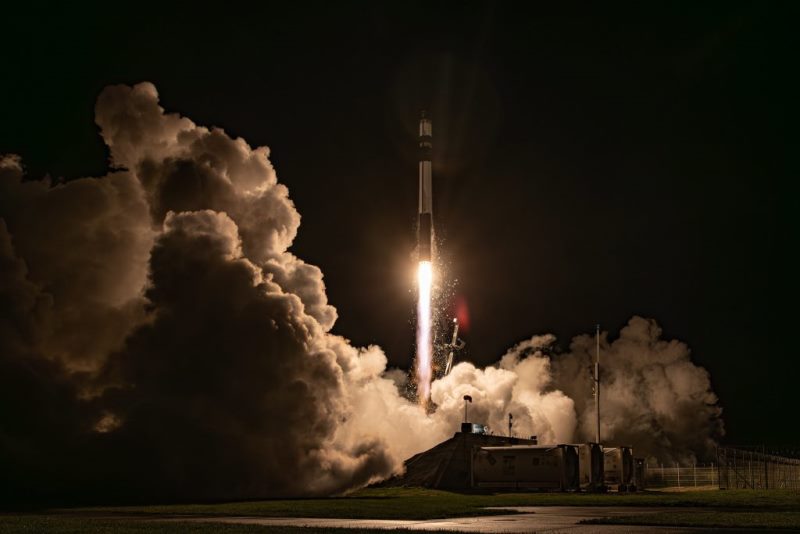
This success represents a significant step forward for global connectivity, with the ambitious goal of connecting any object, anywhere on the planet, including in the most remote areas, to transmit essential data in near real-time to enable informed decisions
On this occasion, Alexandre Tisserant, CEO of Kinéis, stated: «Kinéis is proud of the success of Electron’s 50th flight. The delicate phase of separating our 5 nanosatellites from the launcher went very smoothly. Our teams are now working to place them in their respective orbits. These first 5 satellites of the constellation mark the beginning of the IoT revolution driven by Kinéis connectivity and pave the way for the launch of full commercial services. Stay tuned for the second launch later this year, and congratulations to the teams!»
Peter Beck, Rocket Lab founder and CEO said: “We’re excited to launch Kinéis on the first of five dedicated Electron launches. Electron is perfectly suited to deploying constellations as we can deliver spacecraft to multiple orbital planes across multiple missions, and we’re proud to make this possible for the team at Kinéis.”
Kineis chooses Rocket Lab´s Electron launcher
Kinéis has selected the American company of New Zealand origin Rocket Lab and its Electron small launch vehicle, dedicated to access to space for small satellites. Rocket Lab has been operating regular flights with Electron since 2017. This first launch for Kinéis corresponds to the 50th launch of the Electron launch vehicle. Electron has strong flight heritage after seven years of launches and meets the constraints of the Kinéis constellation, which is positioned on 5 precisely defined orbital planes. With 5 satellites placed in orbit per launch, Kinéis is the sole passenger on each of the five launches, enabling it to control its launch schedule and improve the operability of satellite positioning.
The 5 launches required to deploy the Kinéis constellation are scheduled to take place between June 2024 and early 2025, a first for the new French space sector. The launches will take place from Rocket Lab Launch Complex 1 on the Māhia Peninsula on the east coast of New Zealand’s North Island. The Rocket Lab mission Control Centre is located in Auckland, the country’s economic capital, around 500 km from the launch base.
The 5 launches required to deploy the Kinéis constellation are scheduled to take place between June 2024 and early 2025, a first for the new French space sector. The launches will take place from Rocket Lab Launch Complex 1 on the Māhia Peninsula on the east coast of New Zealand’s North Island. The Rocket Lab mission Control Centre is located in Auckland, the country’s economic capital, around 500 km from the launch base.
A Goal of Global Connectivity
Thanks to its constellation of 25 nanosatellites, Kinéis’ mission is to connect an object anywhere in the world (including black points) and transmit useful data to users, in near real time, from any point on the globe. Kinéis operates for a global market (with subsidiaries in the United States, Brazil and Singapore) in fields that represent major challenges for mankind, its activities and its environment today: prevention of natural risks (detection of forest fires, floods, drought, pollution, etc.), agriculture, traceability of wild and farmed animals, monitoring of infrastructures and energy networks, monitoring of transport and logistics, monitoring of commercial and scientific maritime activities. The applications are infinite and the benefits considerable: risk reduction, anticipation of breakdowns, optimization of activities, etc.
Above, image credited to Kinéis
